Original press photographs from golf's newspaper archives, hung with the paper trail still attached. The front is the shot. The back is the provenance.
Golf art & finds · Est. by the Three Cypress Club
Three Cypress
Gallery
Original press photographs from golf's newspaper archives, hung with the paper trail still attached.
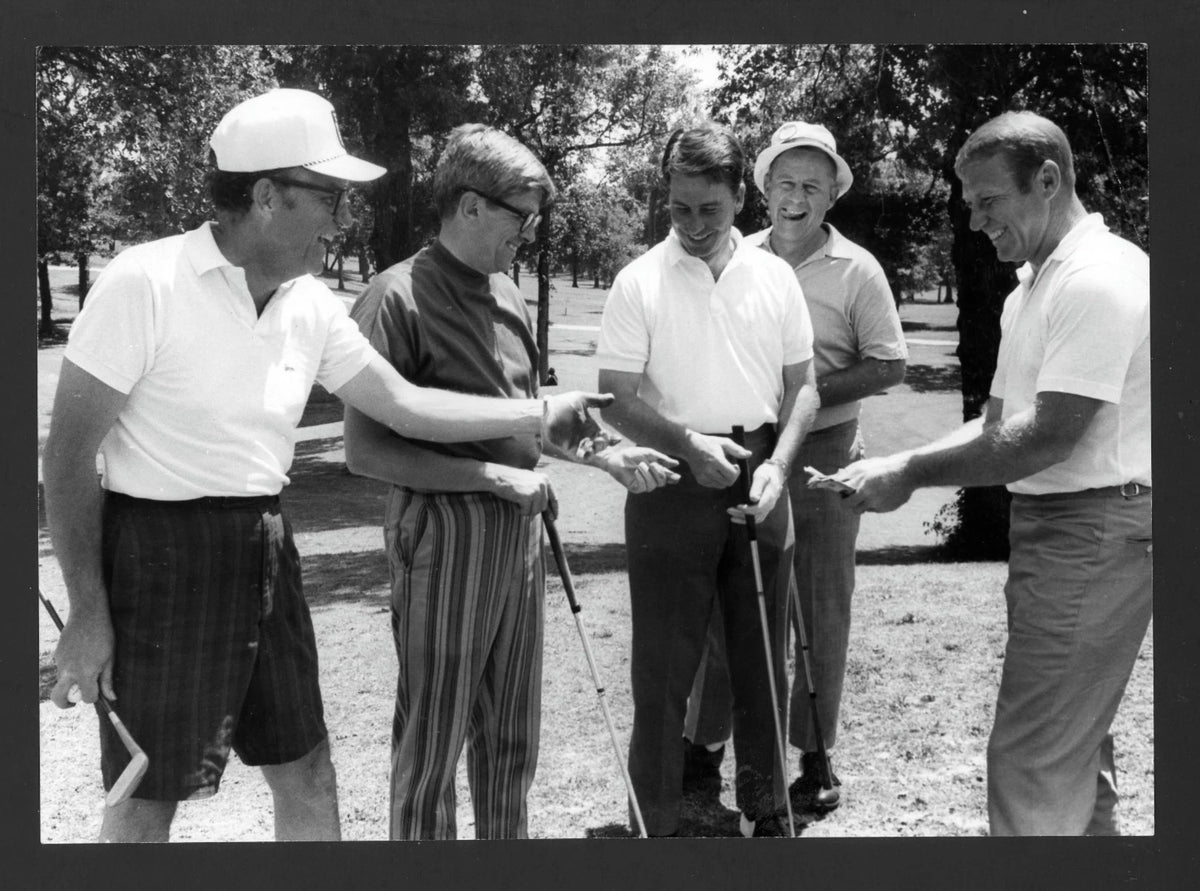
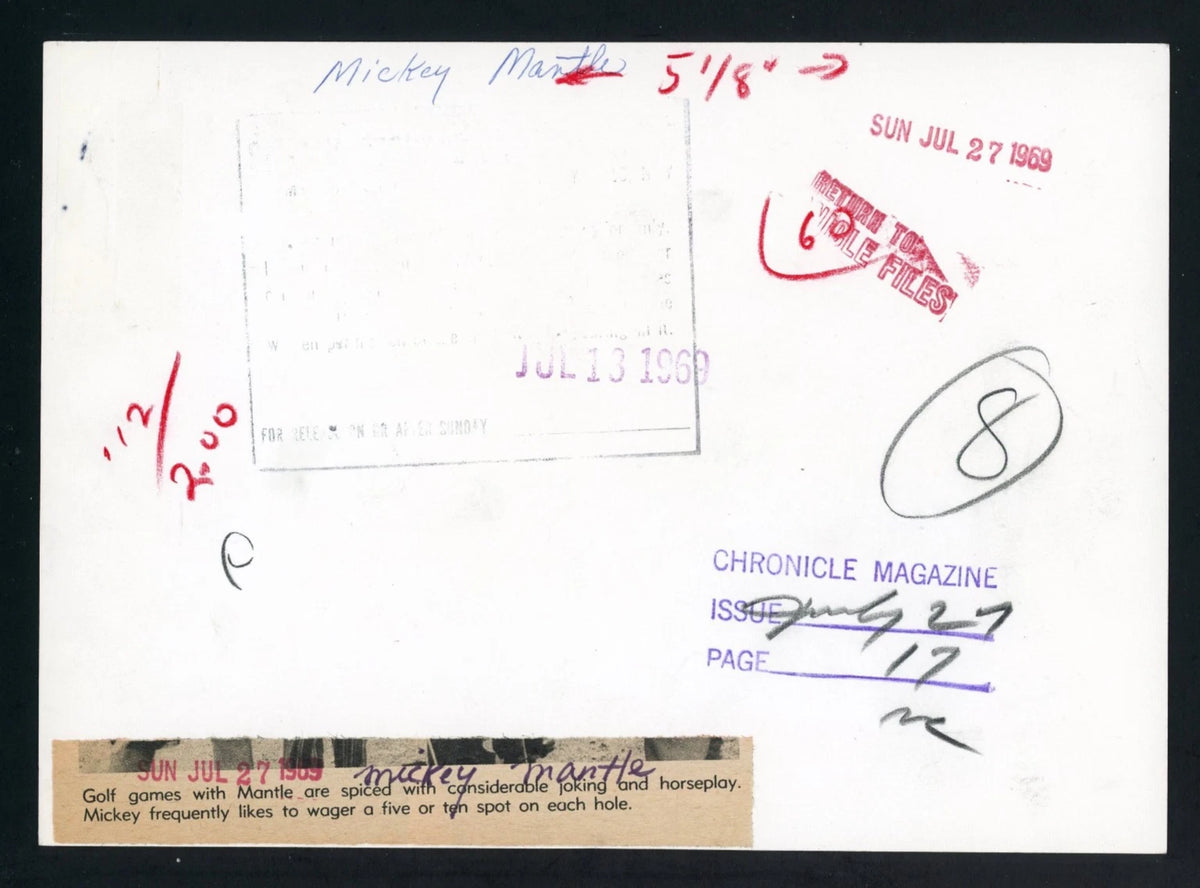
Mickey Mantle and company, settling the bets. Chronicle Magazine, July 27, 1969, page 17.PRESS PRINT · VERSO DATED JUL 13 AND JUL 27, 1969
How to read a press print
The back of the print is the provenance.
Every photograph here left a newspaper library with its paper trail still on it: the caption sheet, the wire slug, the credit, the date stamp, the grease-pencil crop. The back tells you who took it, when it ran, and which generation of print you are holding.
1
2
3
4
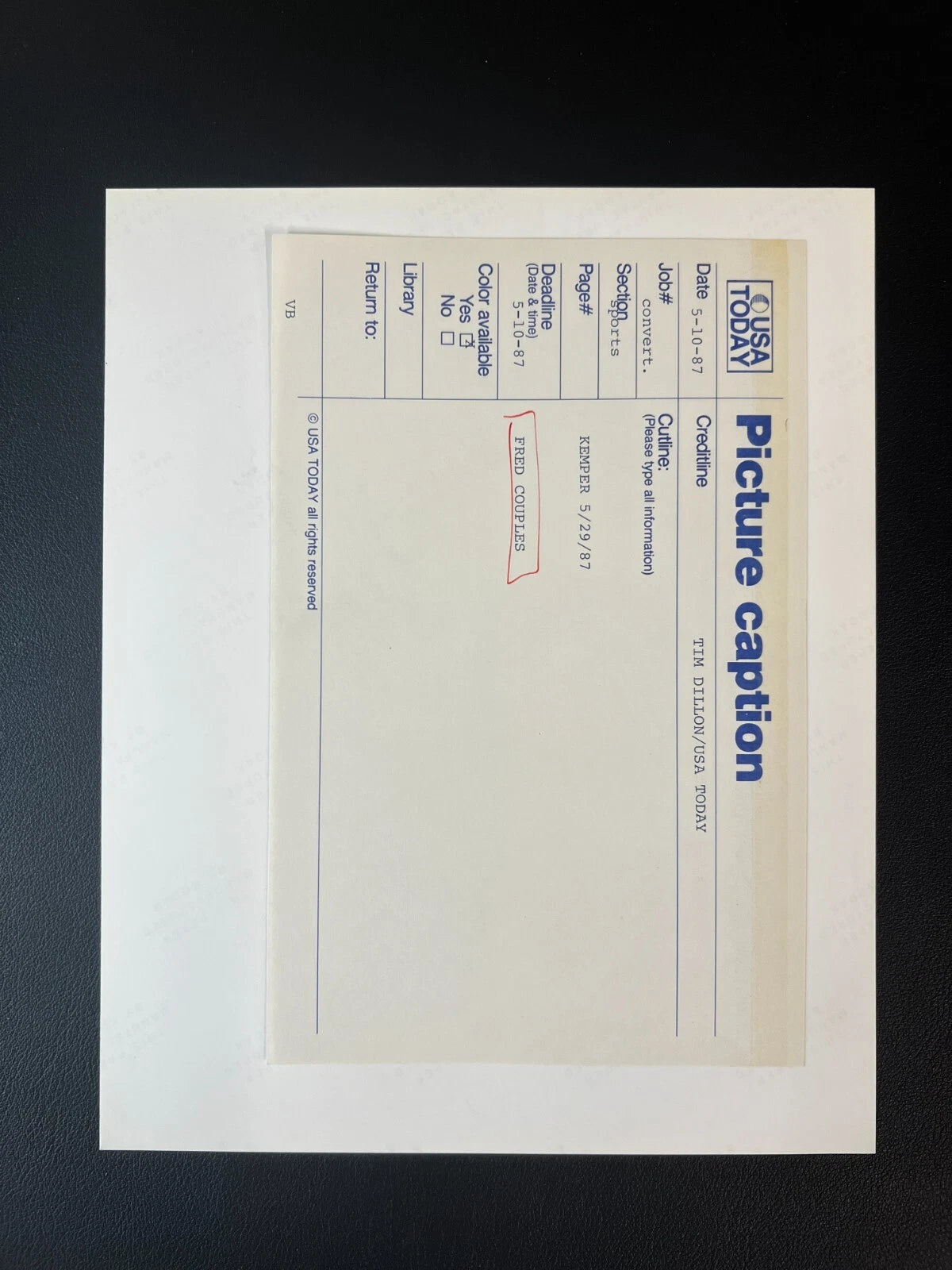
- 1THE CREDITLINE
Who took it and for whom. Here, Tim Dillon for USA Today.
- 2THE CUTLINE
The event and date typed on the sheet: Kemper, 5/29/87. A caption sheet records what the desk planned; only a printed clipping proves a picture ran.
- 3THE SUBJECT
Circled in red by the desk: Fred Couples.
- 4THE DATES
The date and deadline fields say 5-10-87, the cutline says 5/29. We note it rather than smooth it over.
TYPE I · II · III · IV
- I
Original negative, printed at the time, within about two years. The first generation, and the one collectors chase.
- II
Original negative, printed more than two years later.
- III
Duplicate negative or wire transmission, printed at the time. Where most wirephotos land.
- IV
Duplicate negative or wire transmission, printed later.
PSA’s classification, the one most of the hobby uses. Paper stock, verso stamps and sharpness decide it. A photographer’s credit stamp, or a paper’s stamp claiming the negative, points to the original negative; a wire slug points to a transmission. A dated stamp tells you the print existed by that day, which is how “at the time” is judged. The Type isn’t the whole story; a Type III of a great moment can be worth more than a Type I of a minor one.
OUR PRACTICE
- i.Original press prints only, one of each. When a print is gone, it stays in the record.
- ii.Described exactly as the verso reads. Where the dates disagree, we say so.
- iii.We don’t assign a Type ourselves. Where PSA or another recognised authenticator has, the placard says so.
- iv.A date stamp means the paper had the print in hand that day. A caption pasted on the back means it ran. Neither is the day the picture was taken, and we don’t treat them as if they were.
- v.Every claim guaranteed for a year, or a full refund. The Provenance Guarantee
SEE THE VERSO
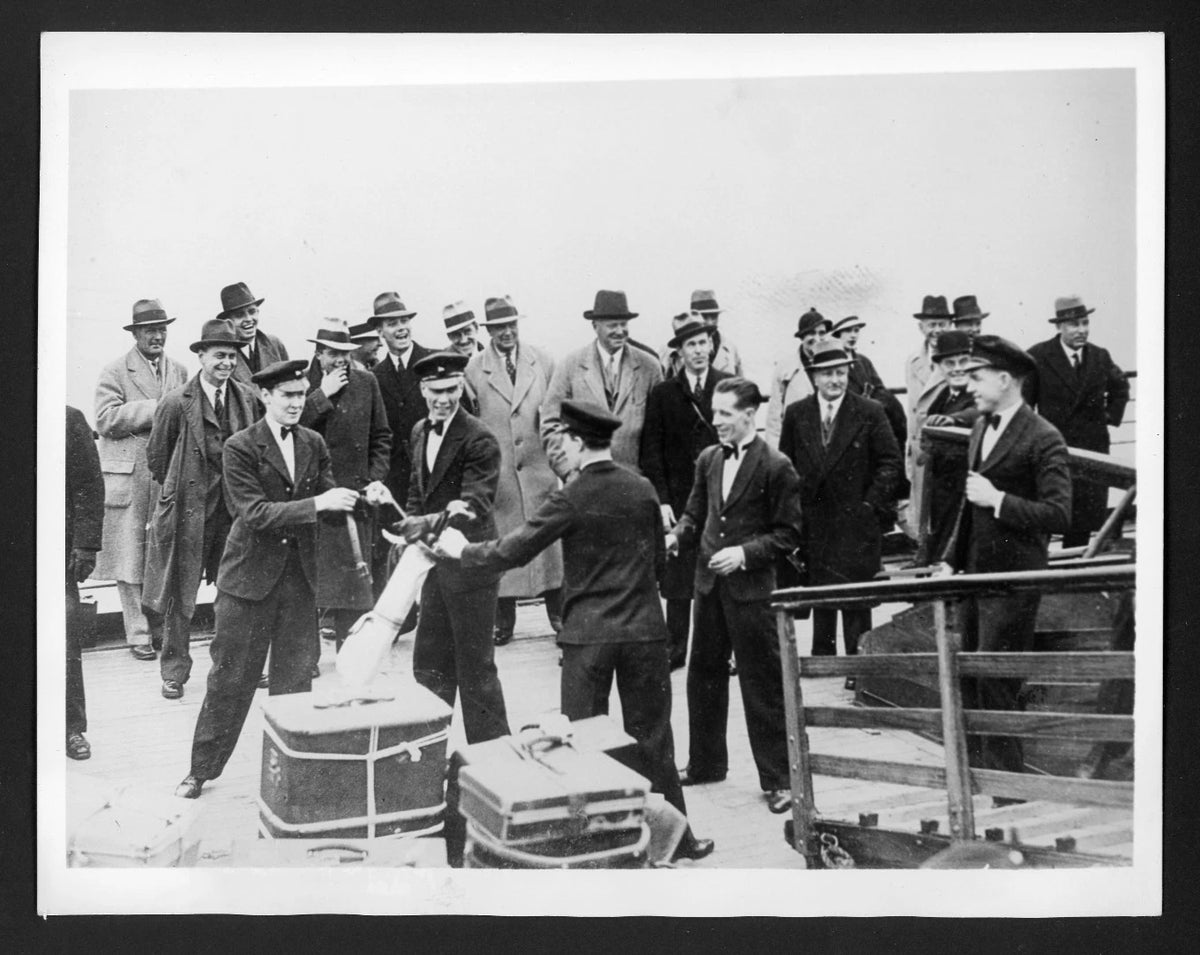
Francis Ouimet's Walker Cup team arrives, 1934
EVENTPrinces Pier, Greenock, Scotland, May 1934
PHOTOGRAPHACME Newspictures, New York
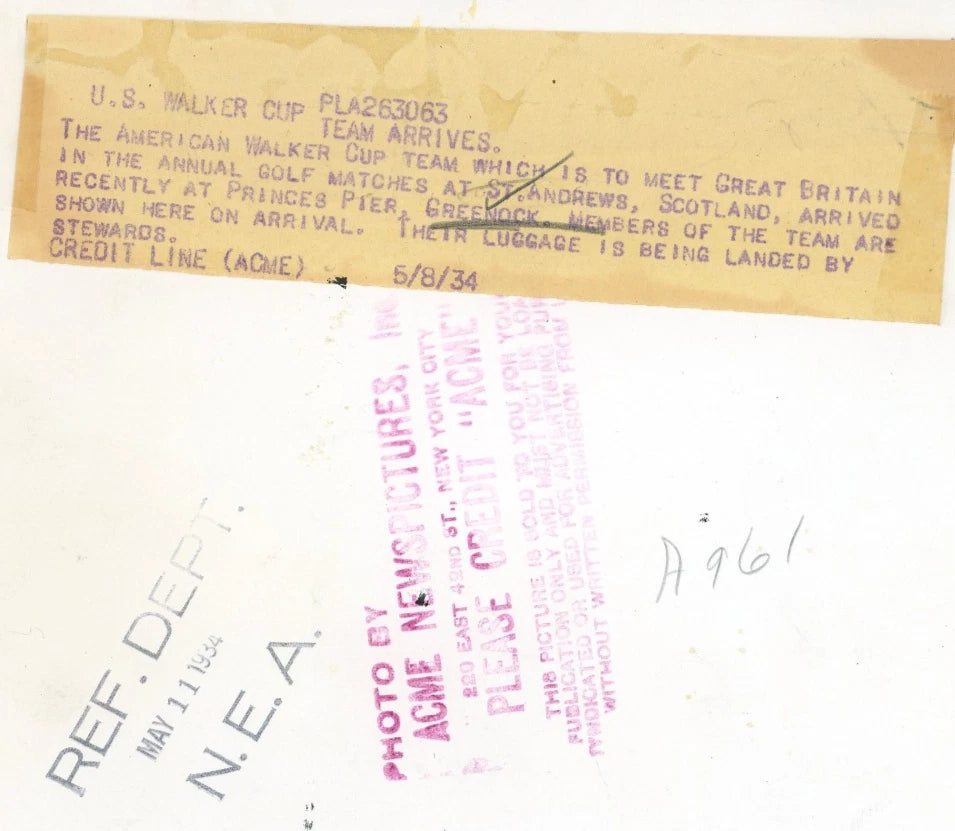
VERSOACME slug PLA263063 dated 5/8/34, pasted caption strip, NEA Reference Department stamp dated May 11 1934, credit-line instruction in red
The American side landing on the Clyde before St Andrews, their luggage coming off by stewards: the last team Ouimet, the 1913 US Open champion, played on. The oldest print on the wall, and the only one from before the war.
Read the file
The captain
Francis Ouimet is why American golf has a story at all. In 1913, aged twenty and still an amateur, he won the US Open at The Country Club in Brookline, the course he grew up across the street from, beating Harry Vardon and Ted Ray in a playoff with a ten-year-old caddie, Eddie Lowery, on the bag. He was the first amateur to win the Open, and the win is still told as the moment golf in America stopped belonging to the British. He won the US Amateur in 1914 and again in 1931.
He played on the first eight American Walker Cup teams, 1922 to 1934, and captained four more after that. In 1951 he became the first captain of the Royal and Ancient Golf Club of St Andrews from outside Britain. His scholarship fund for caddies, begun in 1949, still runs today.
The trip
St Andrews in May 1934 was Ouimet's last match as a player, and he came as playing captain. His team came ashore at Princes Pier, Greenock, on the Clyde, days before the match on the Old Course on May 11 and 12. They won 9 to 2, with one match halved, to lead the series eight to none. Ouimet won his singles, 5 and 4. Chandler Egan, US Amateur champion thirty years earlier, made his debut at fifty. Lawson Little and Johnny Goodman won both their matches, and later that month Little won the Amateur Championship at Prestwick, 14 and 13 in the final.
The side: Francis Ouimet, captain; George Dunlap, Chandler Egan, Johnny Fischer, Johnny Goodman, Lawson Little, Max Marston, Gus Moreland and Jack Westland.
The verso, as it reads
U.S. WALKER CUP TEAM ARRIVES. PLA263063. The American Walker Cup team which is to meet Great Britain in the annual golf matches at St. Andrews, Scotland, arrived recently at Princes Pier, Greenock. Members of the team are shown here on arrival. Their luggage is being landed by stewards. CREDIT LINE (ACME) 5/8/34
A pasted caption strip with the credit-line instruction in red; the NEA Reference Department stamp dated May 11, 1934, the first day of the match; A961 in pencil. The ACME date, May 8, was Ouimet's forty-first birthday.
Reading the caption
The caption calls the match annual. It was played every year from 1922 to 1924 and every other year after that. It names no one in the frame, so neither do we: whether Ouimet is among the men on the pier is a question for a face-by-face comparison, not an assumption.
The agency
ACME Newspictures was founded in 1923 and worked alongside the Newspaper Enterprise Association. United Press bought it in December 1951. The NEA Reference Department stamp shows this print was kept in a newspaper library's files, not only passed across a wire desk.
Open questions
- Whether Ouimet appears in the frame.
- The paper, date and page on which this frame ran.
- The liner that carried the team to the Clyde. A seller’s listing for a matching print names the RMS Cameronia; we have not confirmed it.
- Whether the frame survives in the UPI and ACME archive under slug PLA263063.
Sources
SEE THE VERSO
Arnold Palmer and Jack Nicklaus, June 1960
EVENTStamped JUN 20 1960
PHOTOGRAPHAP Wirephoto
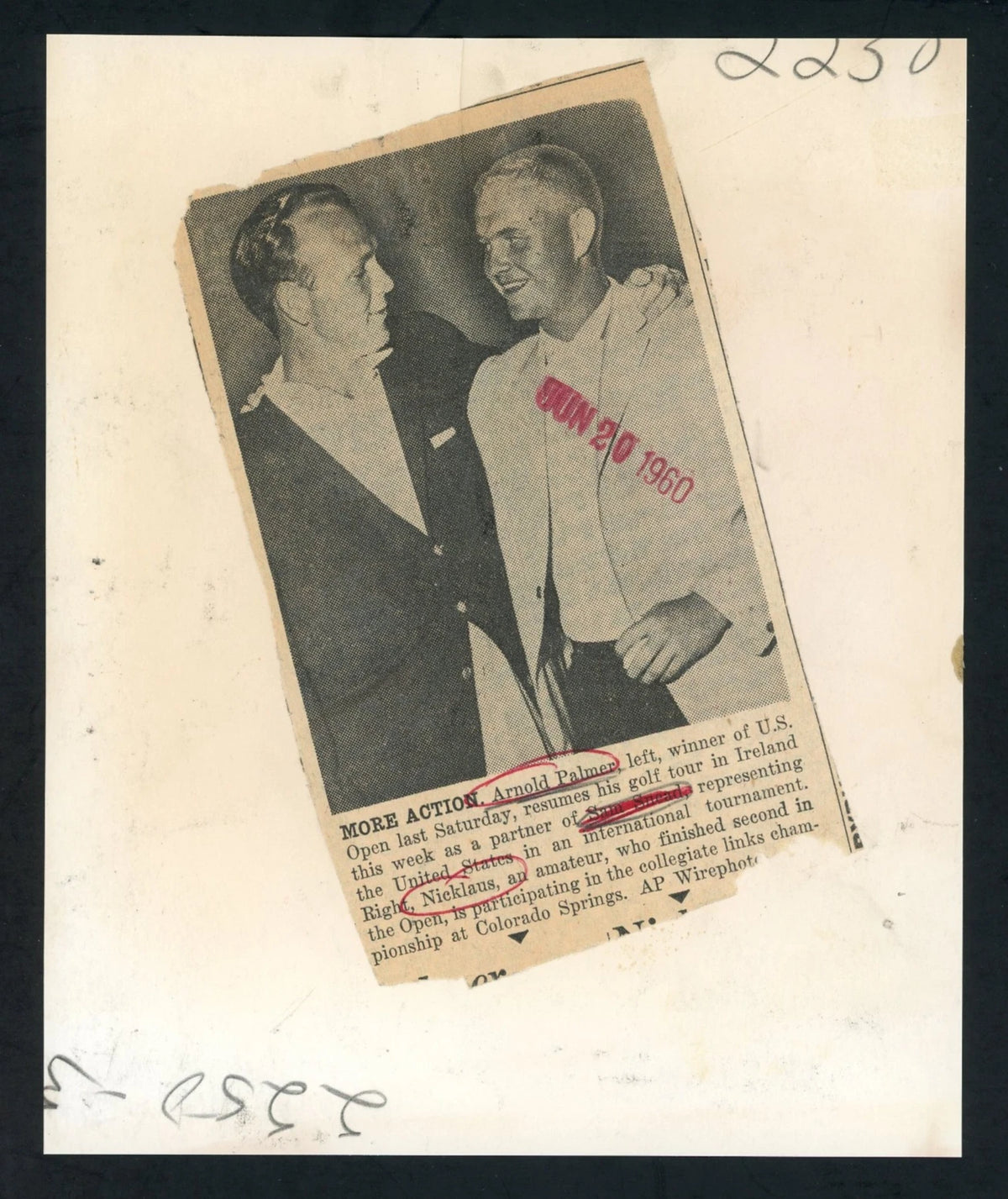
VERSOThe printed clipping still attached, both names ringed in red by the desk, file numbers in pencil
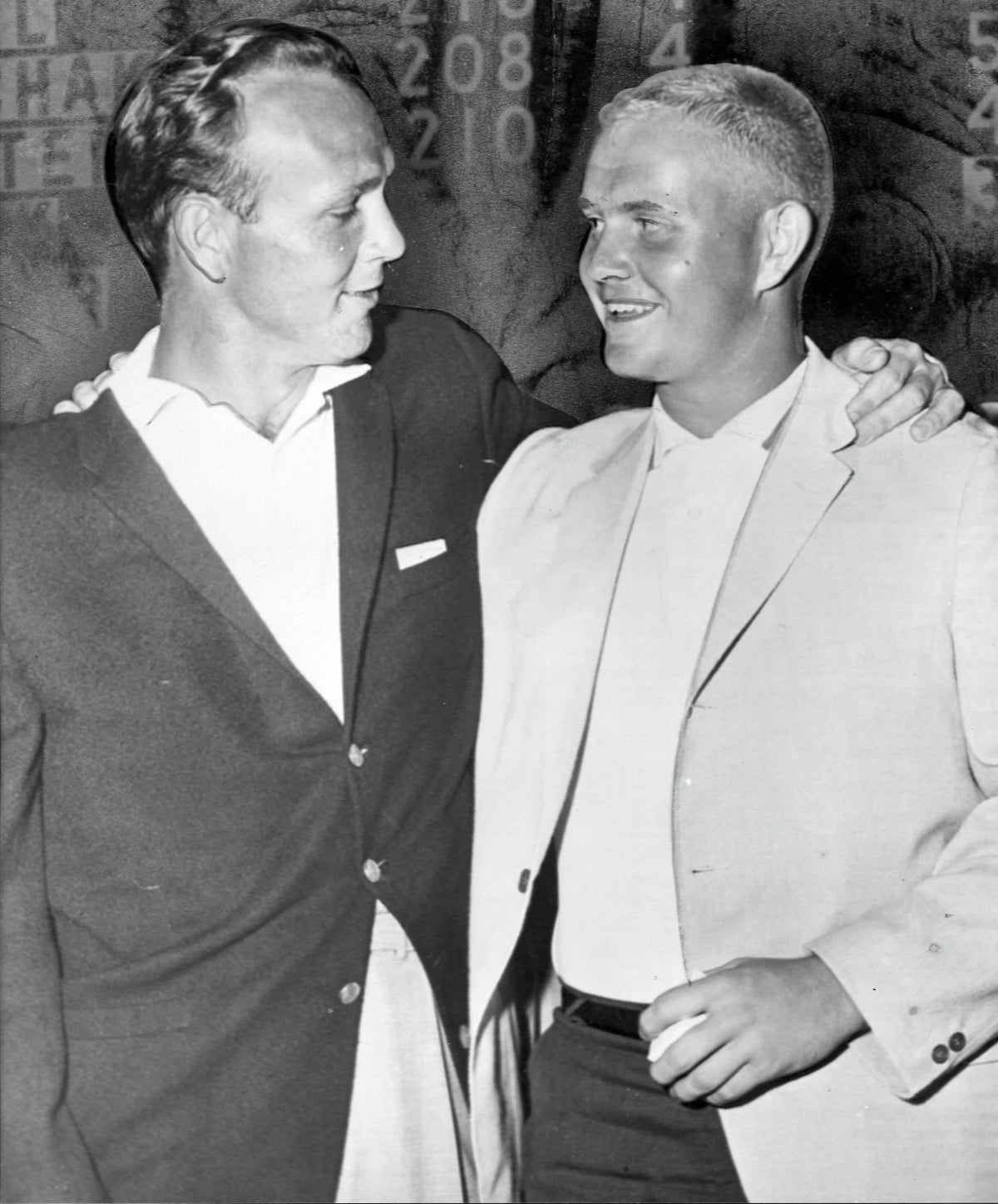
Palmer after the 1960 US Open, and Nicklaus, then an amateur who had finished second. The desk stamped it June 20. The clipping on the back names them both, and proves the paper ran it.
Read the file
The day
The 1960 US Open was played at Cherry Hills Country Club, near Denver, from June 16 to 18. The last 36 holes were played on Saturday, June 18, as was the custom then.
Arnold Palmer began the final round seven strokes behind. He went round in 65 to finish on 280, four under par, and won by two. Jack Nicklaus, a 20-year-old amateur, was in it all afternoon and finished second on 282. Ben Hogan, then 47, was tied for the lead on the 71st tee. He found the water, made a triple bogey and finished tied for ninth. Three generations of the game on one Saturday.
The wire
AP Wirephoto began on January 1, 1935. The Associated Press sent photographs over leased telephone lines: a print was wrapped around a spinning cylinder and scanned, its tones sent as an electrical signal, and the receiving station turned the signal back into a negative and made a print. A print marked AP Wirephoto is usually one of these received prints, made at the far end of the wire.
Reading the back
The stamp reads JUN 20 1960, the Monday, two days after Palmer won. It records a day the paper had the print in hand, not when the shutter was pressed; a date stamp alone never proves a picture ran. The attached clipping does: it is the printed caption, cut from the paper and fixed to the back after the picture was used, and the desk has ringed both names in red. The pencilled file numbers belong to the paper's library.
Open questions
- Where and when the frame was made. Cherry Hills that week is likely; the back does not say. A related AP frame of the two, in a different pose, is captioned Denver, June 18, 1960, the day of the last 36 holes. That makes the Saturday the likeliest day for ours, but until the exact frame turns up in the AP record we treat it as likely, not settled.
- Which paper received the print and ran the clipping.
- The photographer. The back gives no credit.
Sources
SEE THE VERSO
Jack Nicklaus, ball in hand
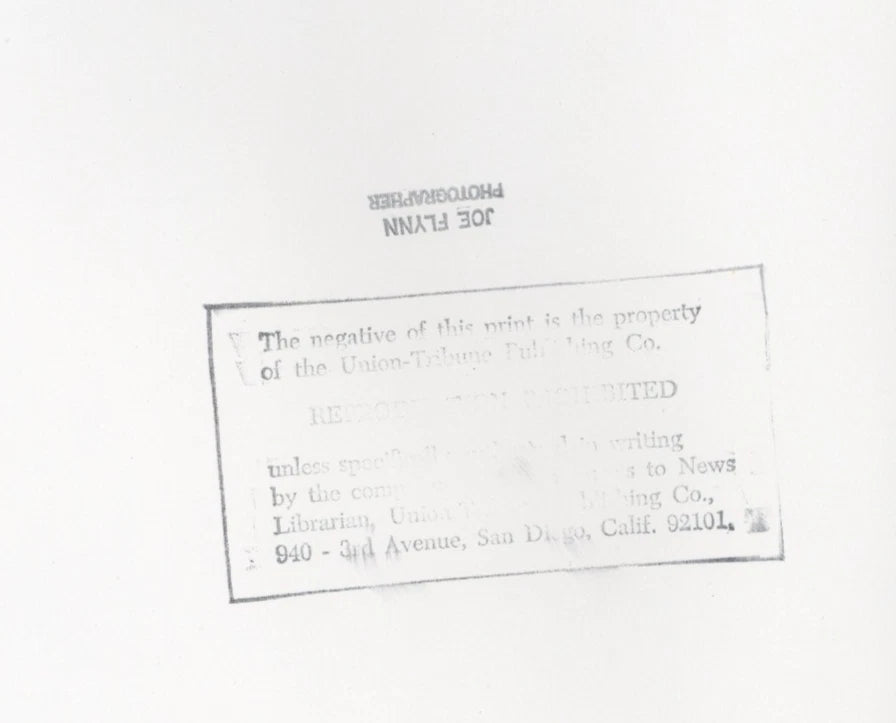
PHOTOGRAPHJoe Flynn, San Diego Union-Tribune
VERSOFlynn’s photographer stamp, and the Union-Tribune library stamp: the negative is the property of the paper, reproduction prohibited without written permission, 940 Third Avenue, San Diego
FRAMINGDouble-framed by Sherman Gallery, Venice, so both faces show
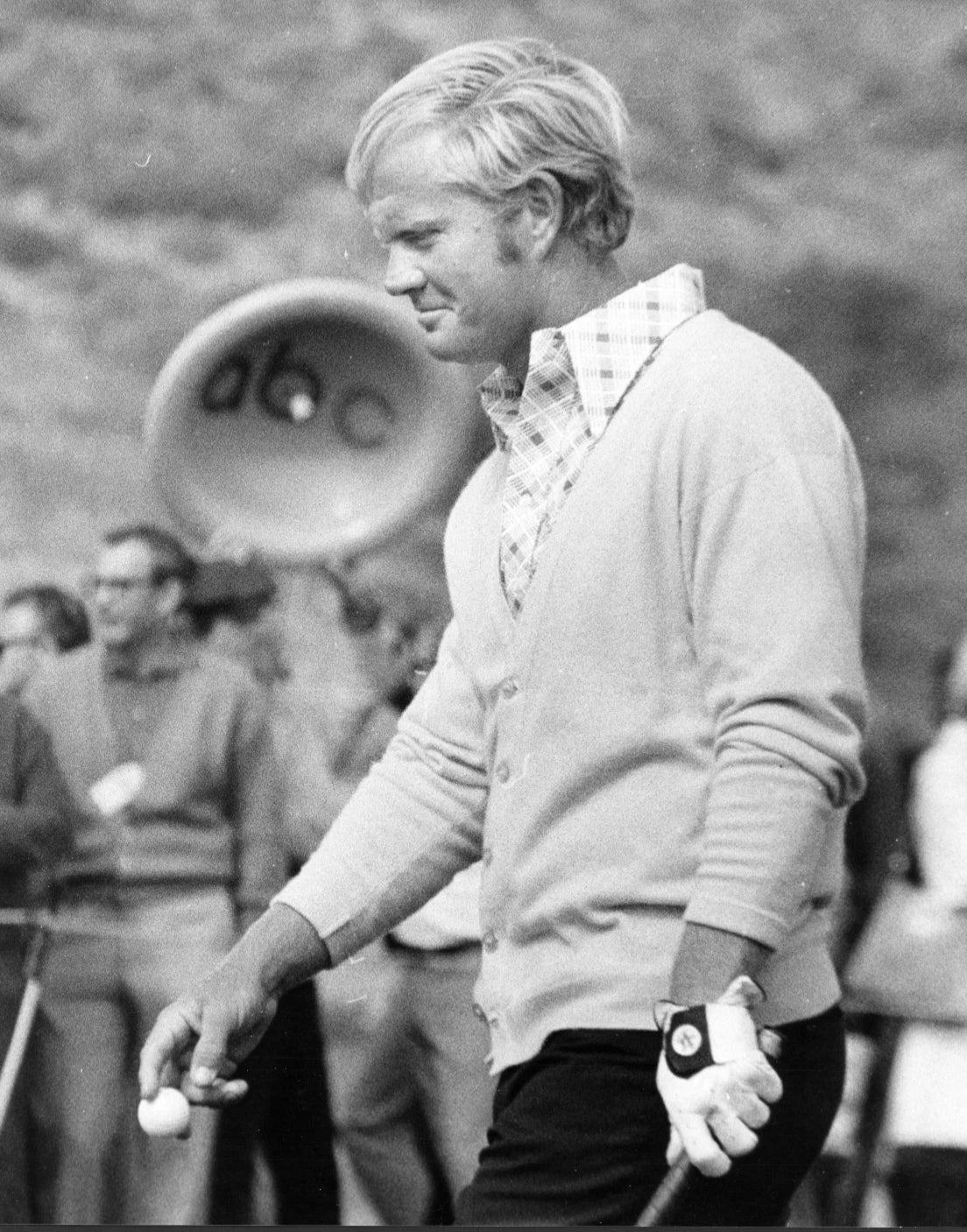
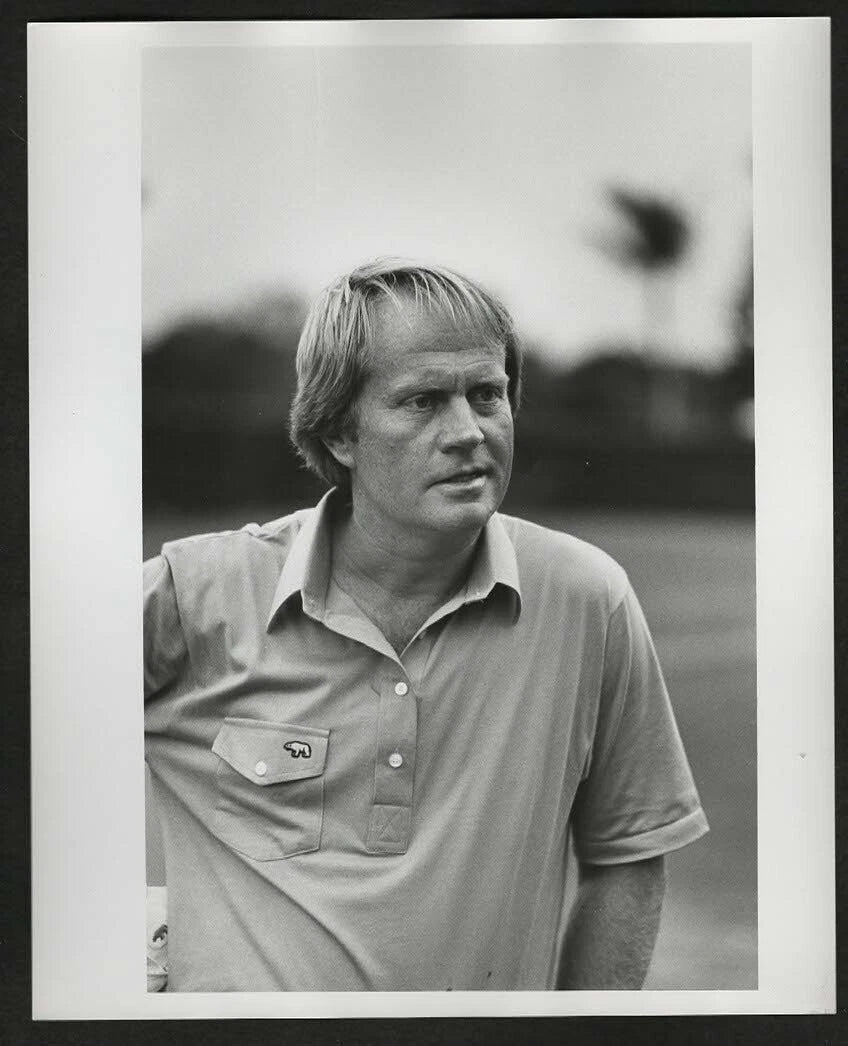
An ABC megaphone behind his shoulder, a ball in one hand and a glove in the other. A staff print from the paper’s own library rather than a wire copy.
Read the file
The player
Nicklaus stands with a ball in one hand and a glove in the other, an ABC megaphone behind his shoulder. ABC began televising golf in 1962. It covered the PGA Championship from 1965 to 1990 and the US Open from 1966 to 1994, along with regular tour events, among them the San Diego Open in 1972 and 1973.
San Diego's tour stop moved to Torrey Pines in 1968, with Andy Williams as host from then until 1988; his name joined the title in 1977. Nicklaus won there once, in 1969, when it was the San Diego Open Invitational.
The paper
The San Diego Union dates from 1868 and the Evening Tribune from 1895. They shared a publisher from 1901 and were known together as the Union-Tribune long before they formally merged on February 2, 1992. The papers worked from downtown San Diego until 1973, when they moved to Mission Valley.
Reading the back
Two stamps. The first is Joe Flynn's photographer stamp. The second is the paper's library stamp: the negative belongs to the paper, reproduction is prohibited without written permission, 940 Third Avenue, San Diego. This is a staff print made for the paper's own files, not a wire copy. The back names no event and gives no date, but the library stamp carries a ZIP code: San Diego, Calif. 92101. ZIP codes began on July 1, 1963, so the stamp was struck no earlier than that.
Open questions
- The date and the event. San Diego is the natural guess; the back does not confirm it.
- Whether 940 Third Avenue was the downtown building. If so, the stamp was made before the 1973 move to Mission Valley. But a library kept using its stamps after a move, so the address alone cannot date the print, or the picture.
- Joe Flynn's years at the paper.
- Which broadcast the ABC megaphone belonged to.
Sources
SEE THE VERSO
Jack Nicklaus, Golden Bear polo
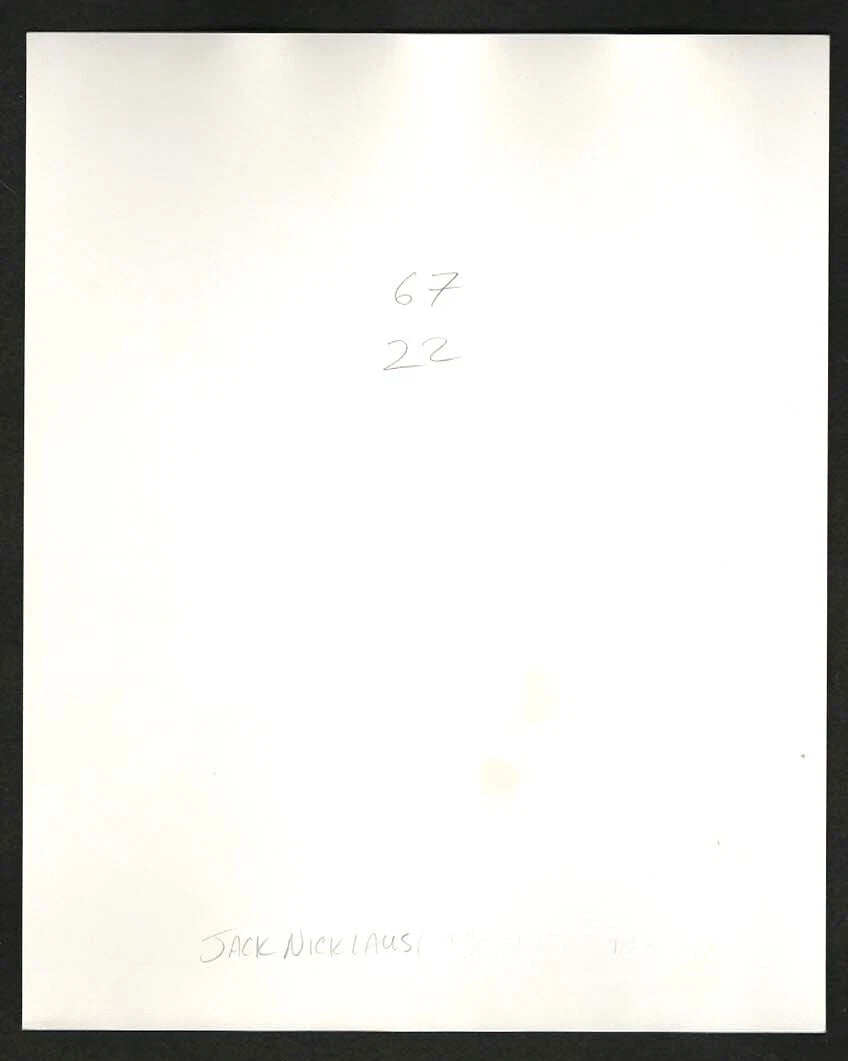
VERSOPencilled JACK NICKLAUS with file numbers 67 and 22
Short sleeves, the Golden Bear on a buttoned flap pocket. The back names the player and nothing else, so neither do we.
Read the file
The player
The back names Jack Nicklaus and nothing more. Short sleeves, the Golden Bear on a buttoned flap pocket, with a long placket and a broad collar.
The nickname is credited to Don Lawrence of the Melbourne Age, around the time Nicklaus turned professional in late 1961. It suited a big, fair-haired young man, and it matched the Golden Bears of Upper Arlington High School in Ohio, whose golf team Nicklaus captained. Barbara Nicklaus has said they were looking for a logo from his first shirt contract in 1961, and settled on the bear after an Australian headline. By 1963 the name had stuck. The bear went on to mark his clothing, his course-design business and the rest of his ventures.
Reading the back
The name is pencilled on the back with two file numbers, 67 and 22. They are a newspaper library's numbers; the back does not say whether either refers to a year. There is no date stamp and no pasted caption, so nothing on the back says when the paper had the print or whether it ever ran.
Open questions
- The date. The logo places the picture after the early 1960s, but no reliable source pins down when it first appeared on his shirts.
- Who made the shirt. Hathaway is the lead to follow: retailers’ newspaper ads from 1972, 1975 and 1976 sell a Jack Nicklaus golf shirt by Hathaway, and the 1975 ad ties the Golden Bear line to it by name. None of the ads uses this photograph, and the shirt has not been matched to a labelled example.
- The photographer, the paper and the event.
Sources
SEE THE VERSO
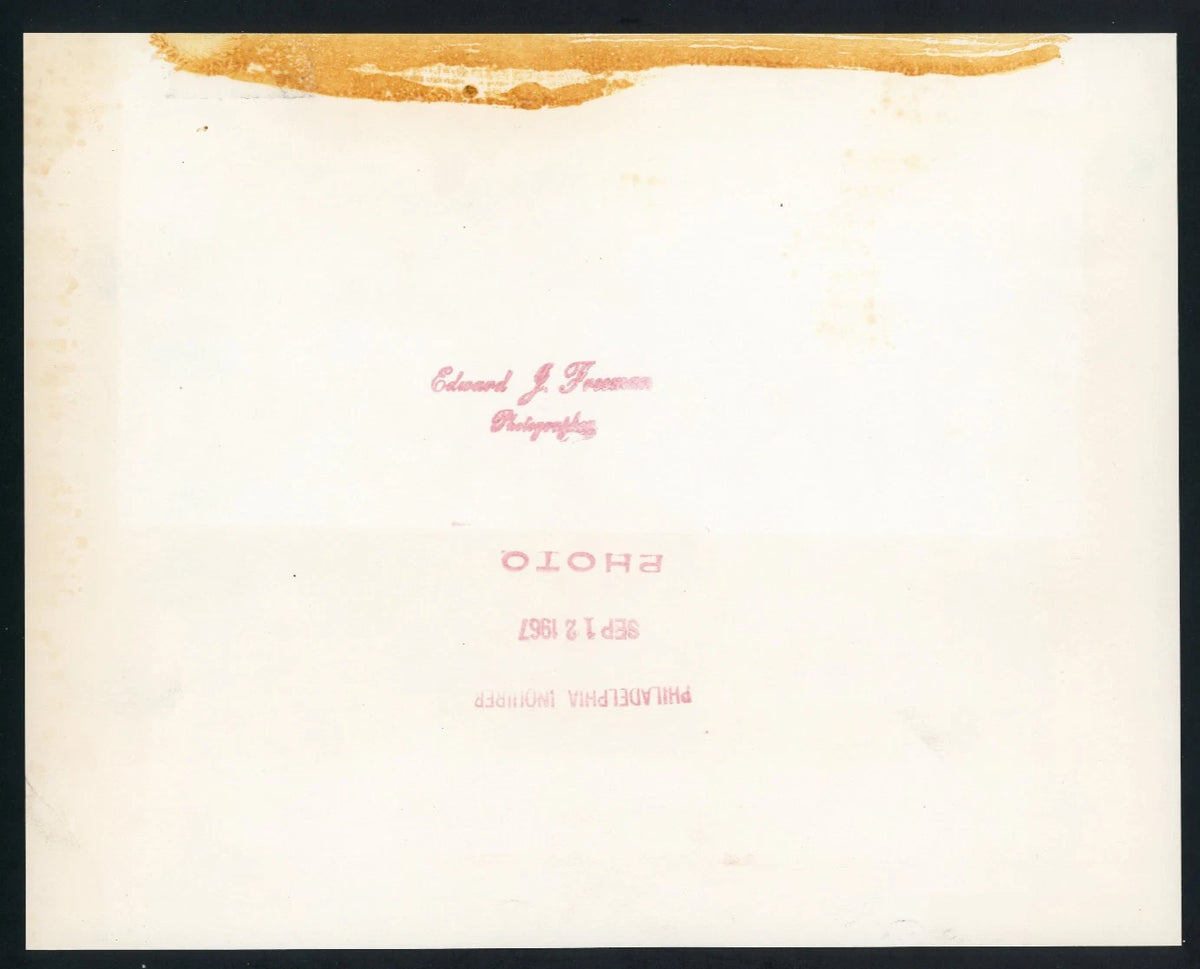
Arnold Palmer, in front of the gallery, September 1967
EVENTStamped Tuesday, September 12, 1967. The back does not say where
PHOTOGRAPHEdward J. Freeman, for the Philadelphia Inquirer
VERSOInquirer PHOTO stamp dated SEP 12 1967, struck upside down to Freeman’s credit stamp; tape residue along the top edge where a clipping was once fixed, now gone
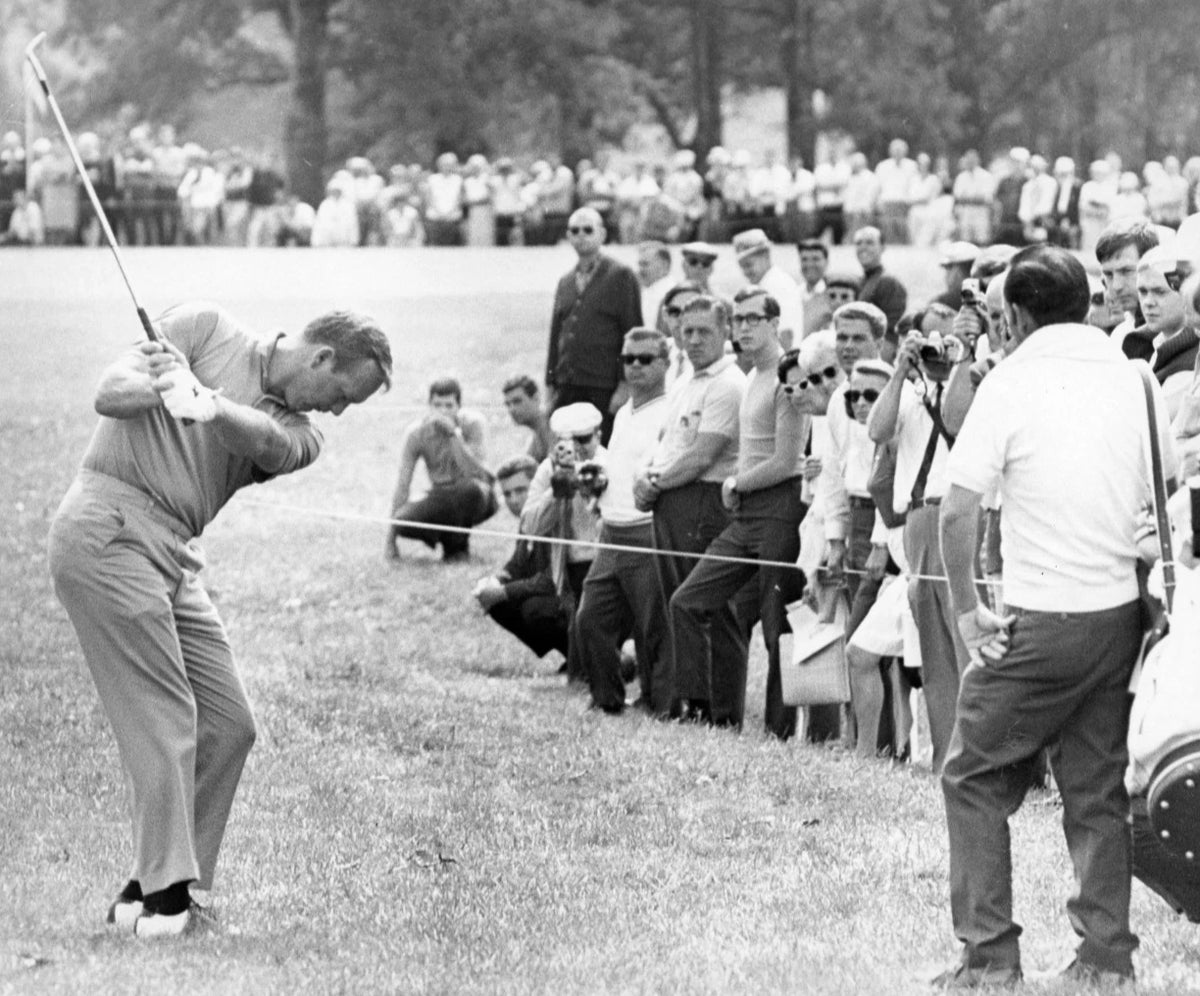
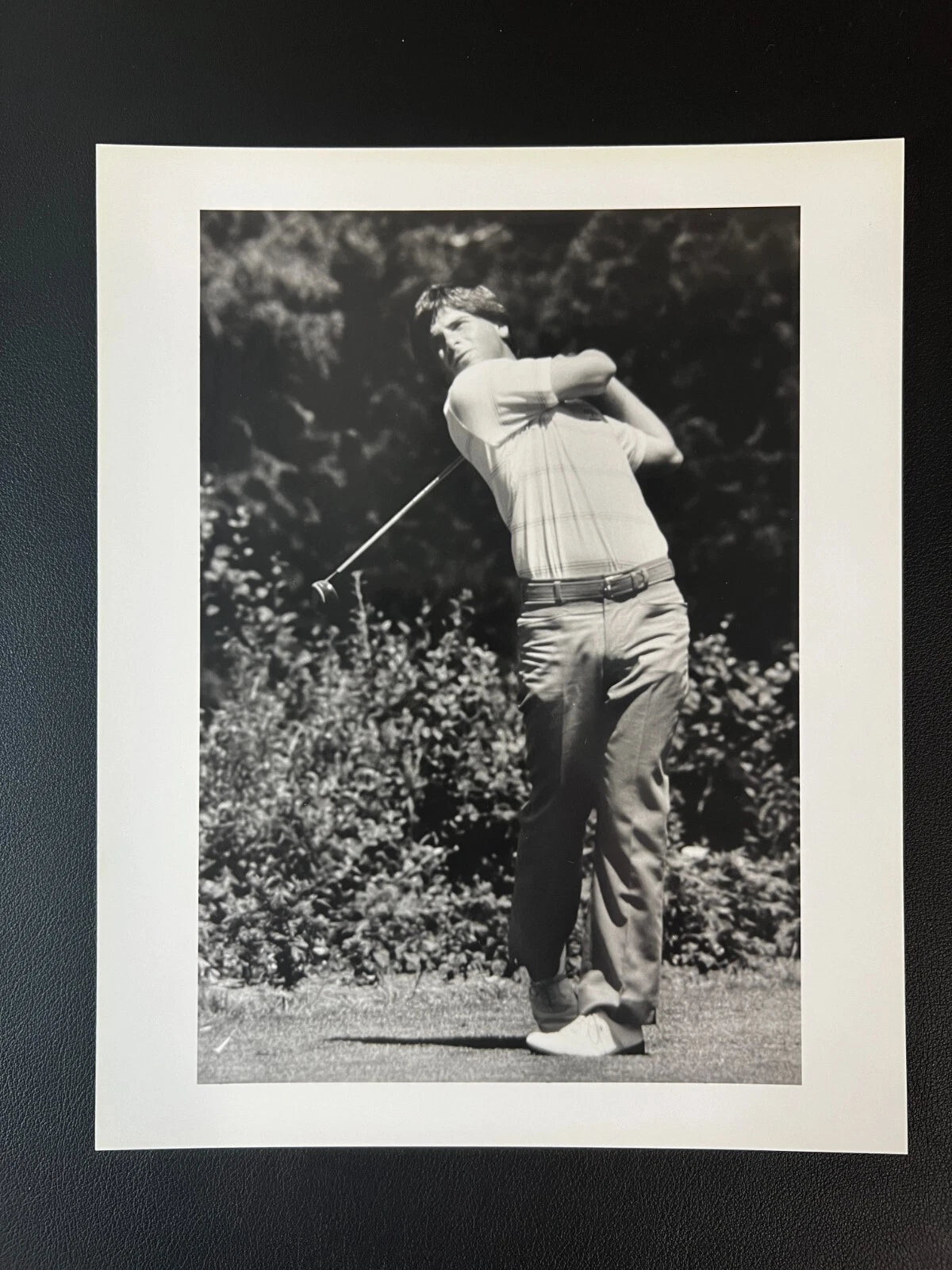
Palmer out of the rough, a few feet from the rope, with the press working inside it. The back names the paper, the photographer and the day, but not the player. An earlier sale of this same print named him as Palmer. The paper’s own caption has not been found, and we say so.
Read the file
In plain terms
This is a newspaper photographer’s own print, made for the Philadelphia Inquirer and kept in the paper’s picture library. The stamps on the back are the library’s marks: who took it, and a day the paper had it in hand. Nobody wrote the golfer’s name on it. An earlier sale of this same print, with the same stamps and the same tape on the back, named him as Arnold Palmer and credited Freeman and the Inquirer. The picture bears that out. But a seller’s title is not the paper’s caption, and until the Inquirer’s own caption turns up, the name rests on that attribution.
The picture
Palmer is just past impact with a lofted club, not a driver: hands low and wrapped, head still down after the ball has gone. He is in the rough a few feet off the gallery rope, playing a recovery, which is why the crowd is this close. Inside the rope the press is at work, and at the rope a spectator holds a home-movie camera. At the right edge a man in a white shirt stands with his back to us, hand on hip, beside a studded tour bag. Very likely the caddie; the print does not say.
Reading the back
Two stamps, two jobs, two hands. Freeman’s credit is in pink script: Edward J. Freeman, Photographer. The library’s stamp, PHOTO / SEP 12 1967 / PHILADELPHIA INQUIRER, sits upside down to it, so the print was stamped at different moments by different people. A newspaper library stamped a print each time it was handled: when it came in, when it was pulled to run, and sometimes when an editor pulled it to look and put it back unused. The New York Times, explaining its own morgue, shows a print stamped five years after it ran and notes that if it had run again, there would be another caption fixed beside the stamp. So a date stamp on its own means “someone at the paper had this in hand that day.” It does not mean the day it ran, and it is never the day the shutter fired. What it does prove is that the picture existed by September 12, 1967, which is what makes this a print of its time.
The printed caption is the proof of use. When a paper ran a picture, the library cut the caption out of that day’s paper and fixed it to the back before refiling the print. Our 1960 Palmer and Nicklaus wirephoto still has its clipping, with both names ringed in red. Here the brown tape residue runs along the top edge, but the clipping is gone, and the player’s name went with it. Tape where a caption would go is a reason to think this print ran in the Inquirer. It is not proof, and a date stamp with no caption could equally be a print pulled that Tuesday for a Classic preview.
For collectors
A photographer’s credit stamp together with the paper’s own dated library stamp is the pattern that points to a print made at the time, in the paper’s darkroom, from the original negative, the evidence PSA weighs for Type I. The seller described it as Type I. We don’t repeat that until an authenticator does; the Register reads Not yet graded. Under angled light the gloss shows faint crazing below Palmer and near the upper-left margin. No tears or pinholes.
The week
September 12, 1967 was a Tuesday. That Sunday, September 17, the Philadelphia Golf Classic finished at Whitemarsh Valley Country Club in Lafayette Hill, just outside the city. Dan Sikes won on 276, two ahead of George Archer. Palmer had won the first Classic there in 1963. Two readings fit the stamp: Freeman photographed Palmer early that week, in practice, or the desk pulled a Palmer print from the files to run with a preview of the tournament, which is how morgue prints were used, and in which case the picture could be from an earlier year. The print cannot tell us which, so we don’t choose.
Palmer’s 1967
He was 37 and still the biggest draw in golf. He won the Los Angeles Open and Tucson that winter and the American Golf Classic at Firestone in August. Twelve days after this stamp he won the Thunderbird Classic at Upper Montclair, New Jersey, by a stroke over a three-way tie that included Jack Nicklaus. He finished the year second on the money list to Nicklaus, $184,065 to $188,998. The year also had its losses: the US Open to Nicklaus at Baltusrol in June, and in August the Pennsylvania Open, by one shot to club pro Bob Ross at Laurel Valley, a few miles from his home in Latrobe.
Open questions
- Whether Palmer played at Whitemarsh that week, in practice or in the Classic itself.
- Whether the Inquirer ran this picture, and on what page. Its issues for September 12 to 18, 1967 are the place to look. Finding the page would give back the lost caption, and probably the event and the round.
- Edward J. Freeman’s years at the Inquirer. Temple University Libraries holds a Philadelphia Inquirer photograph collection.
- The man with the bag.
Sources
- 1967 PGA Tour
- IVB-Philadelphia Golf Classic
- Dan Sikes
- Thunderbird Classic
- Golf Digest: Arnold Palmer and the one that got away
- Philadelphia Inquirer Open
- The Lively Morgue: David W. Dunlap, A Treasure House of Photographs (The New York Times)
- Temple University Libraries: Philadelphia Inquirer Photograph Collection
- Earlier sale listing of this print, naming Palmer
SEE THE VERSO
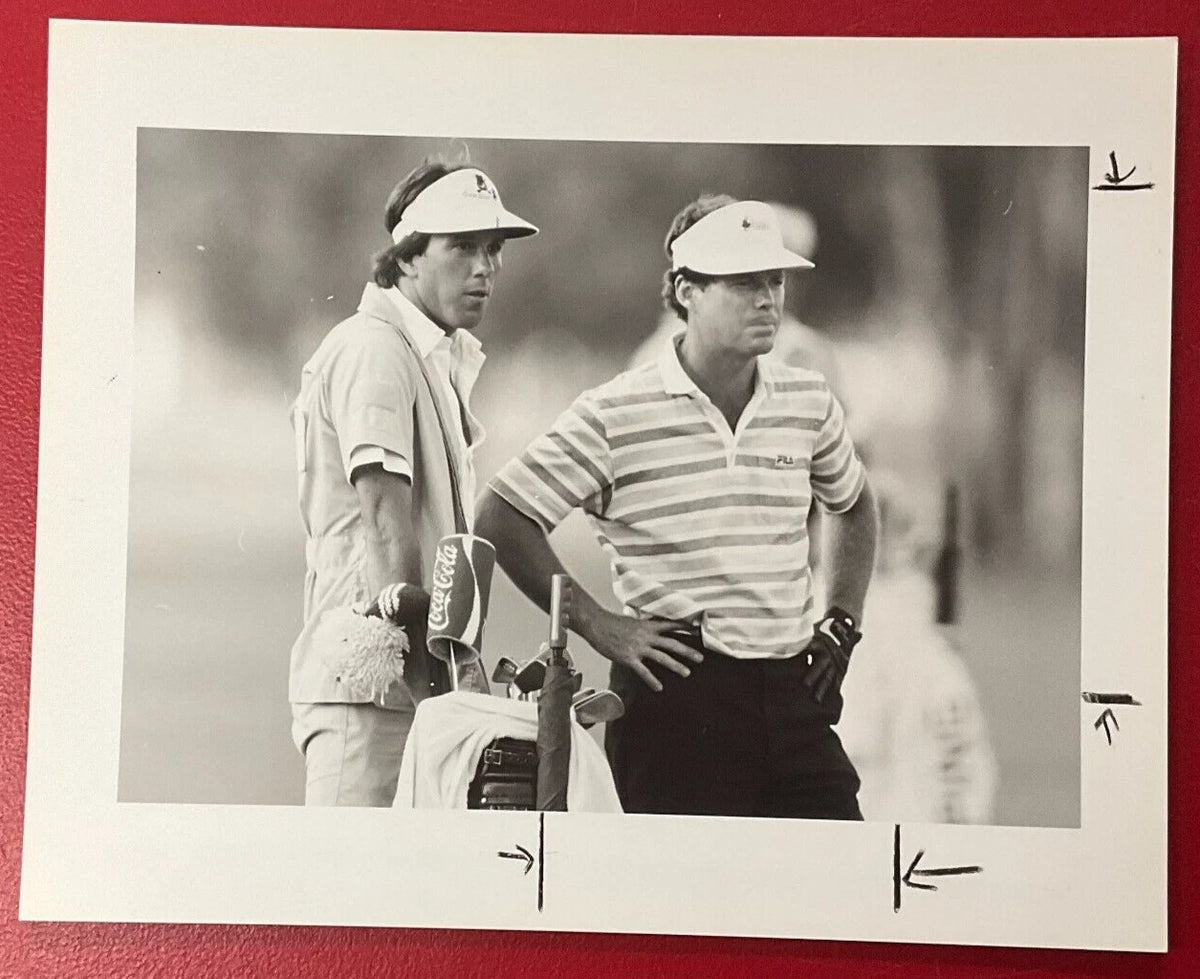
Bruce Edwards and Tom Watson, 1986
EVENTDoral-Eastern Open, March 1986
PHOTOGRAPHDan Helms / Duomo
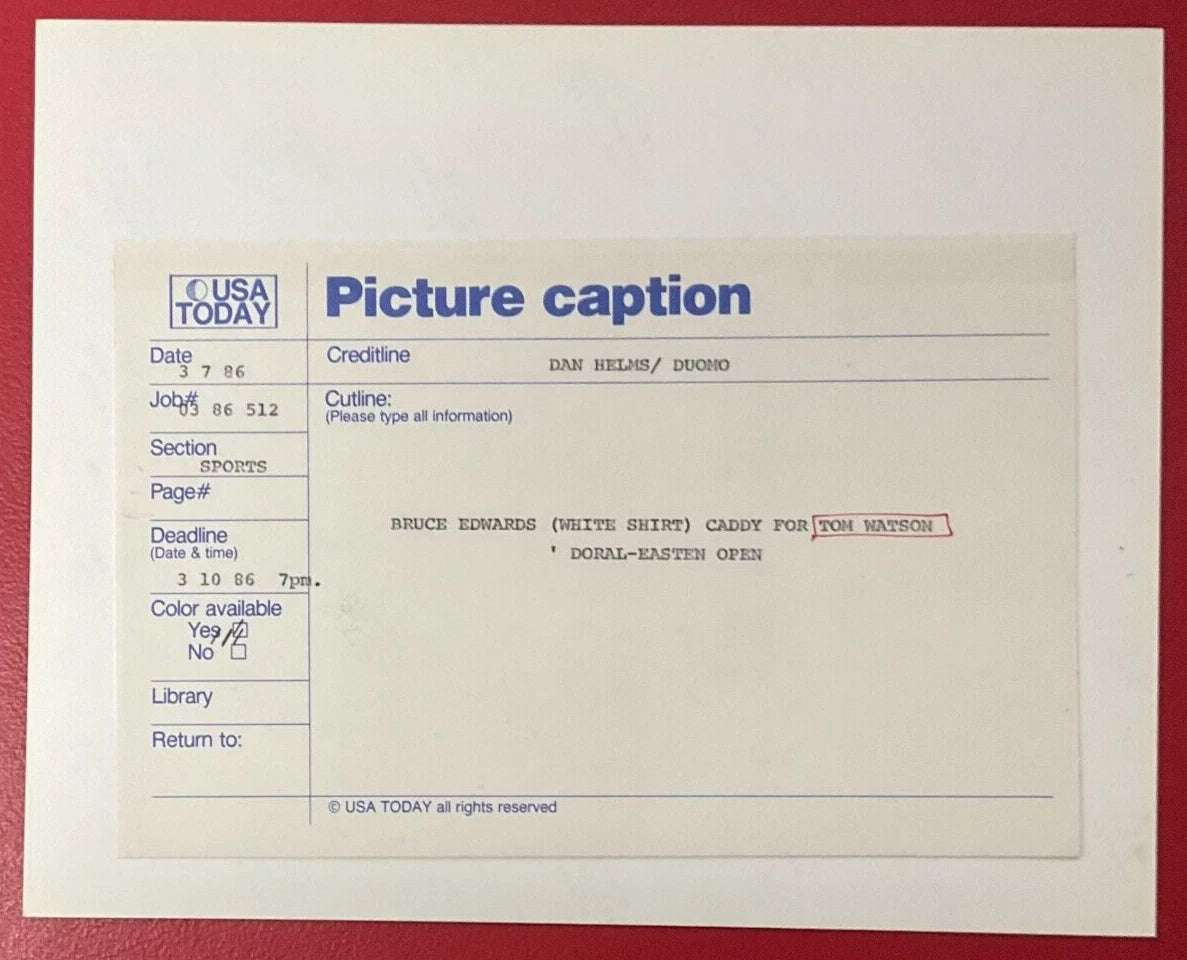
VERSOUSA Today caption card dated 3 7 86, job 03 86 512, Sports section, deadline 3 10 86 7pm, Tom Watson boxed in red
The caddie named first on the card, the player second. Edwards stands with the bag, Watson with his hands on his hips and FILA across his chest. The desk’s crop marks close in on Watson alone.
Read the file
The week
The Doral-Eastern Open was played on the Blue Monster at Doral, near Miami, and finished on Sunday, March 9, 1986. Andy Bean and Hubert Green tied on 276, twelve under par, and Bean won with a birdie at the fourth hole of sudden death: his third Doral title, the first time anyone had won the event three times.
Watson came to Miami in a lean stretch. His last Tour win had been the 1984 Western Open; his next would be the 1987 Nabisco Championship.
The caddie
Bruce Edwards, born in Wethersfield, Connecticut, in 1954, went to work for Watson in 1973 and, apart from a few seasons with Greg Norman, stayed on his bag for the rest of his life. He was diagnosed with ALS in 2003 and kept working that year as long as he could, while Watson spent the season raising money for research. Edwards died on April 8, 2004, at 49, and entered the Caddie Hall of Fame that year. In 2005 Watson and the writer John Feinstein founded the Bruce Edwards Foundation for ALS research.
The paper
USA Today launched on September 15, 1982, built on colour photographs and graphics.
Reading the back
The card is dated 3 7 86, the Friday of the second round, with a deadline of 3 10 86 at 7pm, the Monday evening after the finish: logged mid-tournament and held open until the result was in. Job 03 86 512 and the Sports tag are the paper's routing marks. The caddie is named first and the player second; Watson's name is boxed in red. The credit reads Dan Helms / Duomo.
On the front, grease-pencil marks frame a narrow crop around Watson, leaving Edwards out even though the card names him first. They show what the desk intended, not what finally ran. Watson’s shirt reads FILA, and a Coca-Cola headcover sits in the bag beside Edwards. FILA dates its Watson agreement to 1979; his Polo sponsorship came in 1993.
Open questions
- Watson's finishing position that week.
- Dan Helms's relationship to Duomo.
- Whether the picture ran, and on what date.
Sources
SEE THE VERSO
Fred Couples, Kemper Open, 1987
EVENTFiled under Kemper, spring 1987
PHOTOGRAPHTim Dillon, USA Today
VERSOTyped caption sheet with credit line, cutline and date fields; subject circled in red; Color available ticked Yes, and the job field reads “convert.”
The date fields say 5-10-87 and the cutline says 5/29. We note it rather than smooth it over.
Read the file
The player
Fred Couples was born in Seattle in 1959 and turned professional in 1980. His first PGA Tour win came at the 1983 Kemper Open at Congressional, in a five-man playoff, which is reason enough for a Kemper story to carry his picture. In 1984 he won the Tournament Players Championship by one over Lee Trevino. In May 1987 he won the Byron Nelson Golf Classic in a playoff over Mark Calcavecchia. Five years later he won the Masters, and became the first American to reach number one in the world ranking.
The week
The 1987 Kemper Open was the first at the Tournament Players Club at Avenel in Potomac, Maryland, after seven years at Congressional. It ran June 4 to 7, and Tom Kite won by seven.
The photographer
Tim Dillon spent his career as a USA Today photojournalist in Washington, covering the White House and Congress, after starting at the Washington Evening Star. Kemper week was local work for the paper's Washington staff.
Reading the back
A typed USA Today caption sheet with credit line, cutline and date fields. The cutline reads Kemper, 5/29/87; the date and deadline fields read 5-10-87; Couples is circled in red. The dates sit in the weeks before Kemper week: May 10 was the final day of his Byron Nelson win, and May 29 the Friday of the Memorial Tournament in Ohio, where he tied for 24th. A reused sheet or a preview filed ahead of the tournament would each account for the record.
Two boxes on the sheet are easy to miss. Color available is ticked Yes, and the job field reads “convert.” A colour version of this picture existed, and the desk may have made the black-and-white print from it. The sheet alone does not say how this particular print was made.
Open questions
- Where and when the frame was made: Avenel, the Memorial or the Byron Nelson.
- Where the colour original is. Tim Dillon’s colour work from spring 1987 is the place to look. (Settled: coverage from June 5, 1987 has Couples in the Kemper field. That places him at the tournament, not this frame.)
- Whether the print ran, and in which edition.
Sources
SEE THE VERSO
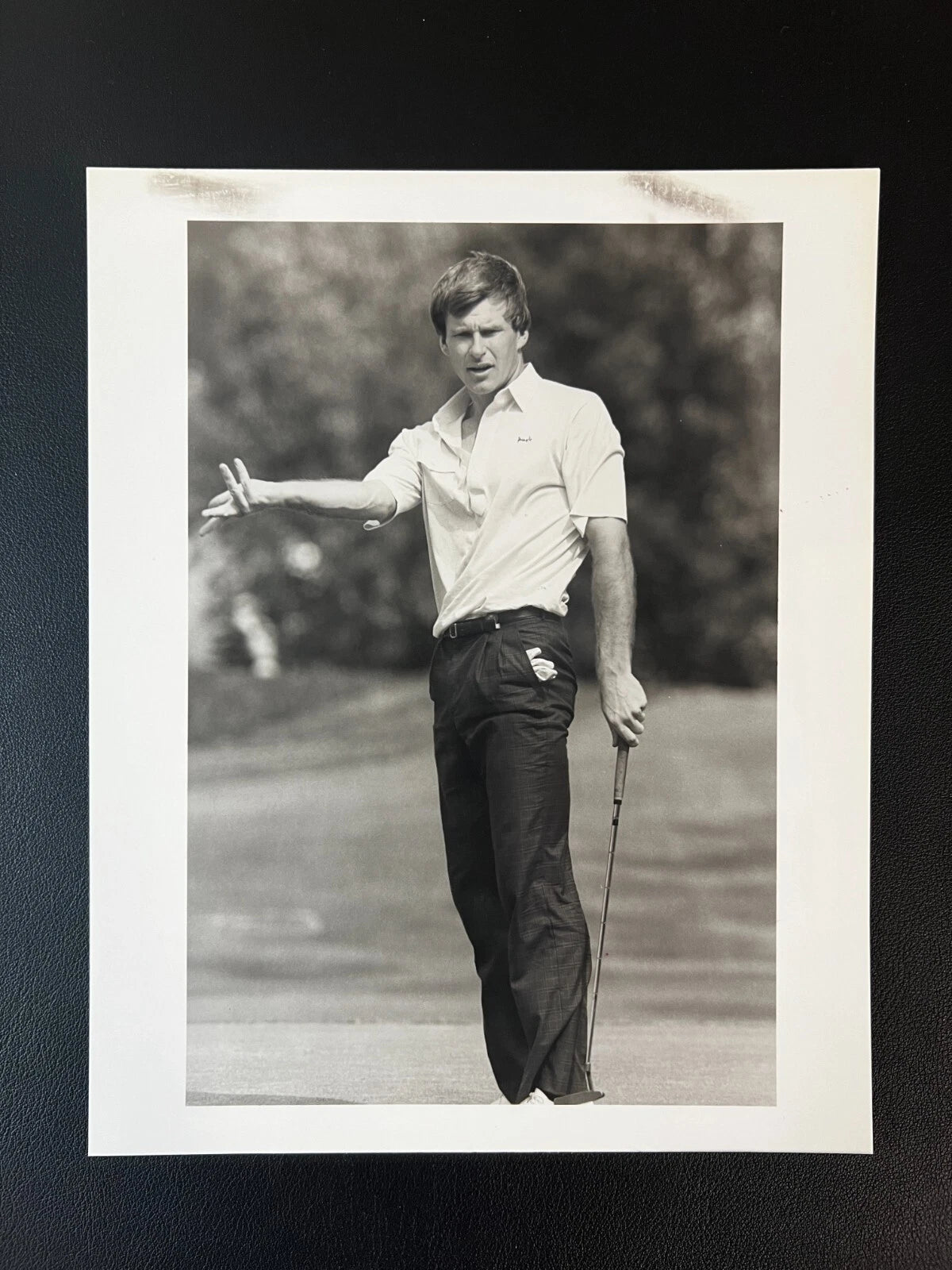
Nick Faldo, the 1988 US Open
EVENTUS Open, June 1988
PHOTOGRAPHRobert Deutsch, USA Today
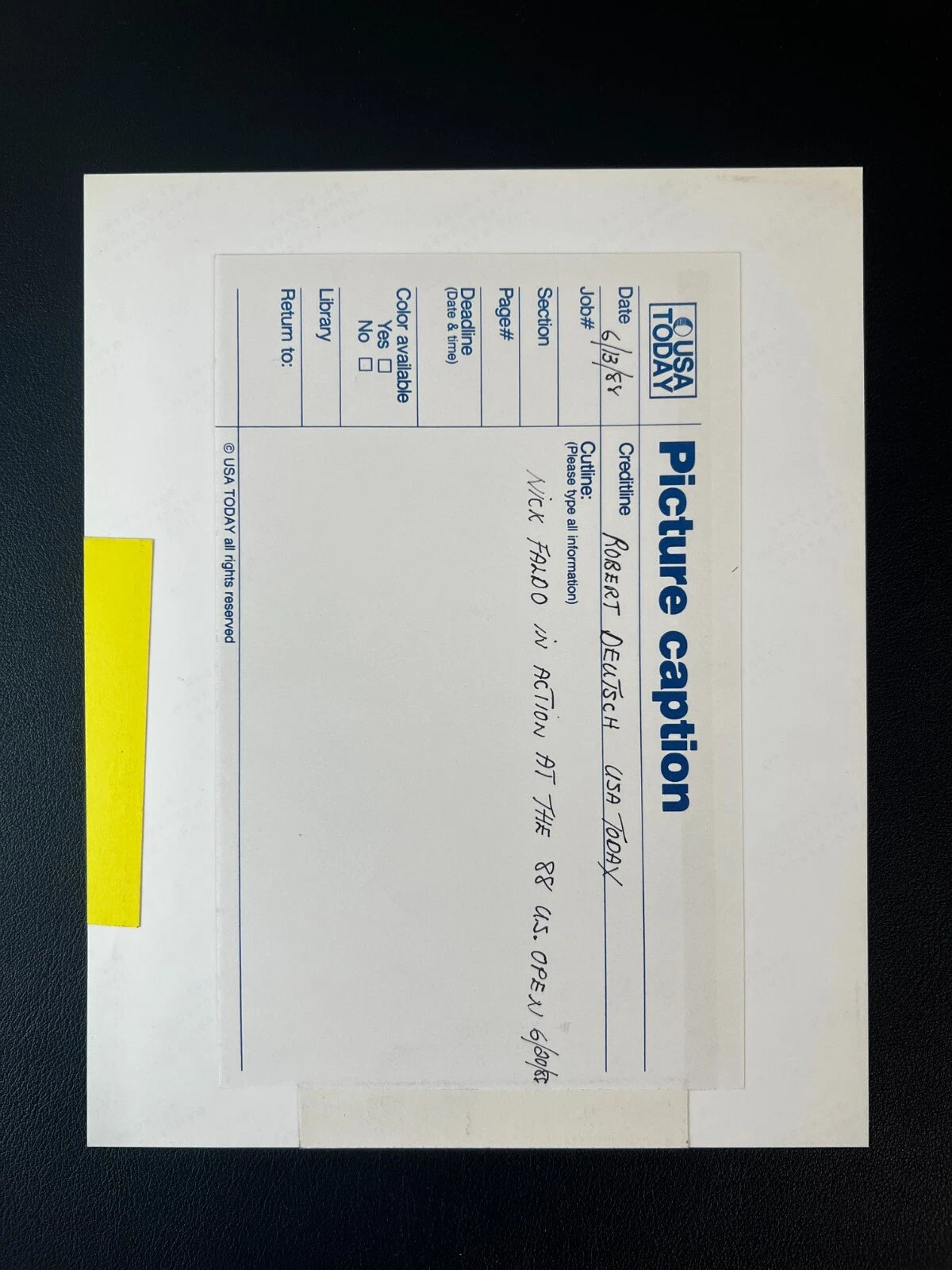
VERSOUSA Today caption card dated 6/13/88, cutline written by hand, the event dated 6/20/88
Gesturing on the green, the putter in his other hand. The card is filled in by hand rather than typed, which is how a desk works on deadline.
Read the file
The week
The 1988 US Open was played at The Country Club in Brookline, Massachusetts, from Thursday, June 16. After 72 holes Curtis Strange and Nick Faldo were tied on 278, six under. Strange three-putted the 17th on Sunday to fall level, then got up and down from a greenside bunker at the 18th to force a playoff. On Monday, June 20, Strange shot 71 and Faldo 75, bogeying three of his last four holes. Strange won by four, and defended the title the following June.
Brookline is where Francis Ouimet won the 1913 US Open, beating Vardon and Ray in a playoff. His 1934 Walker Cup team hangs on this wall.
The player
Faldo came to Brookline as the reigning Open champion, having parred every hole of his final round at Muirfield in 1987 to win by one. His next majors came quickly: the Masters in 1989 and 1990, both in playoffs, the Open at St Andrews in 1990 and at Muirfield again in 1992, and a third Masters in 1996. Six in all.
The photographer
Robert Deutsch joined USA Today as a staff photographer in 1983 and covered news, sport and portraiture for the paper across several decades.
Reading the back
A USA Today caption card dated 6/13/88, the cutline written by hand, the event dated 6/20/88: the Monday of the playoff. The card's own date is a Monday a week earlier, which fits a job opened before championship week and filed when it ended.
Open questions
- Whether the frame comes from the Monday playoff or earlier in the week.
- Whether the picture ran, and on what date.
Sources
SEE THE VERSO
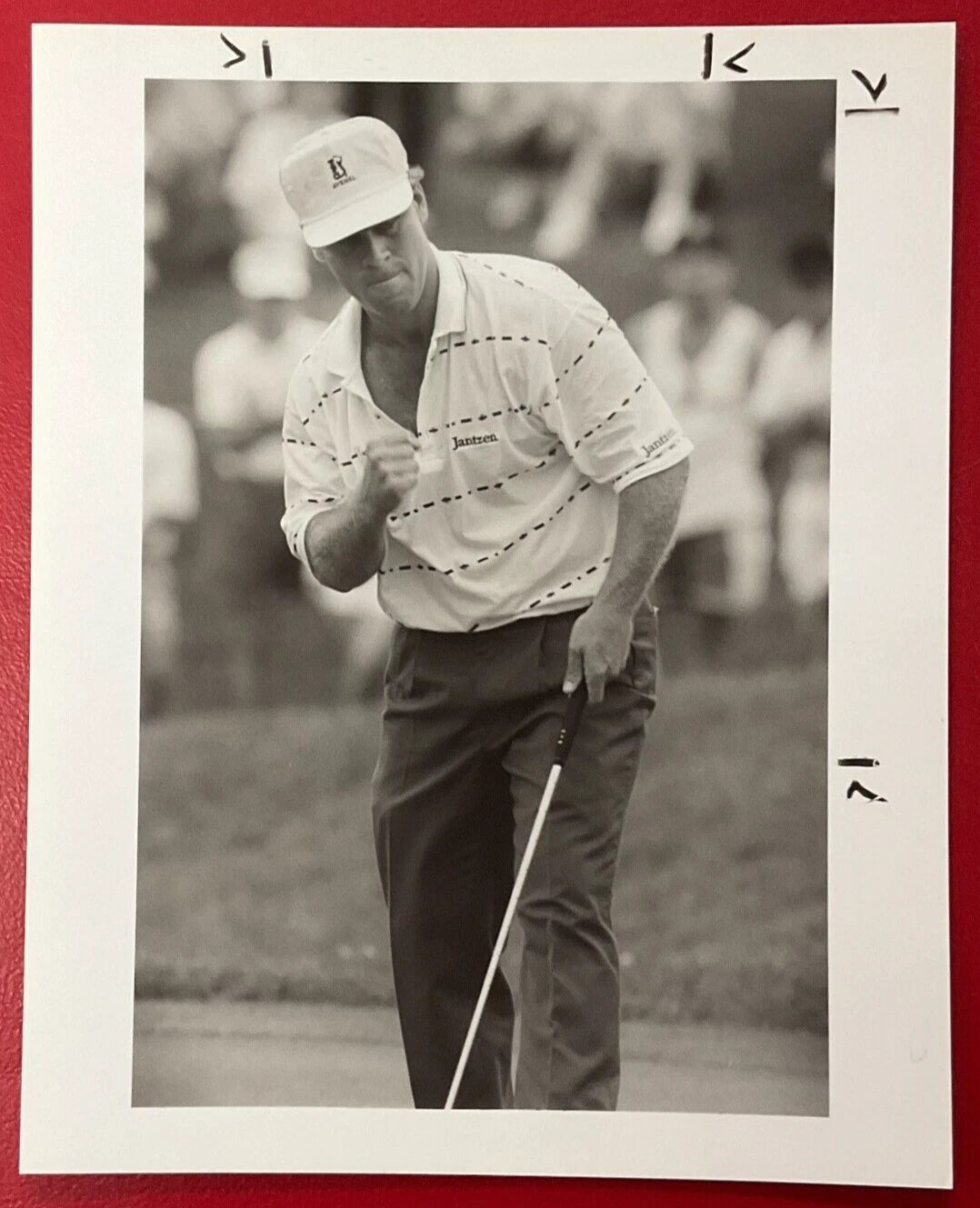
Hal Sutton, 1991 Kemper Open
EVENTKemper Open, Potomac, Maryland, June 1991
PHOTOGRAPHRussell Beeker, USA Today
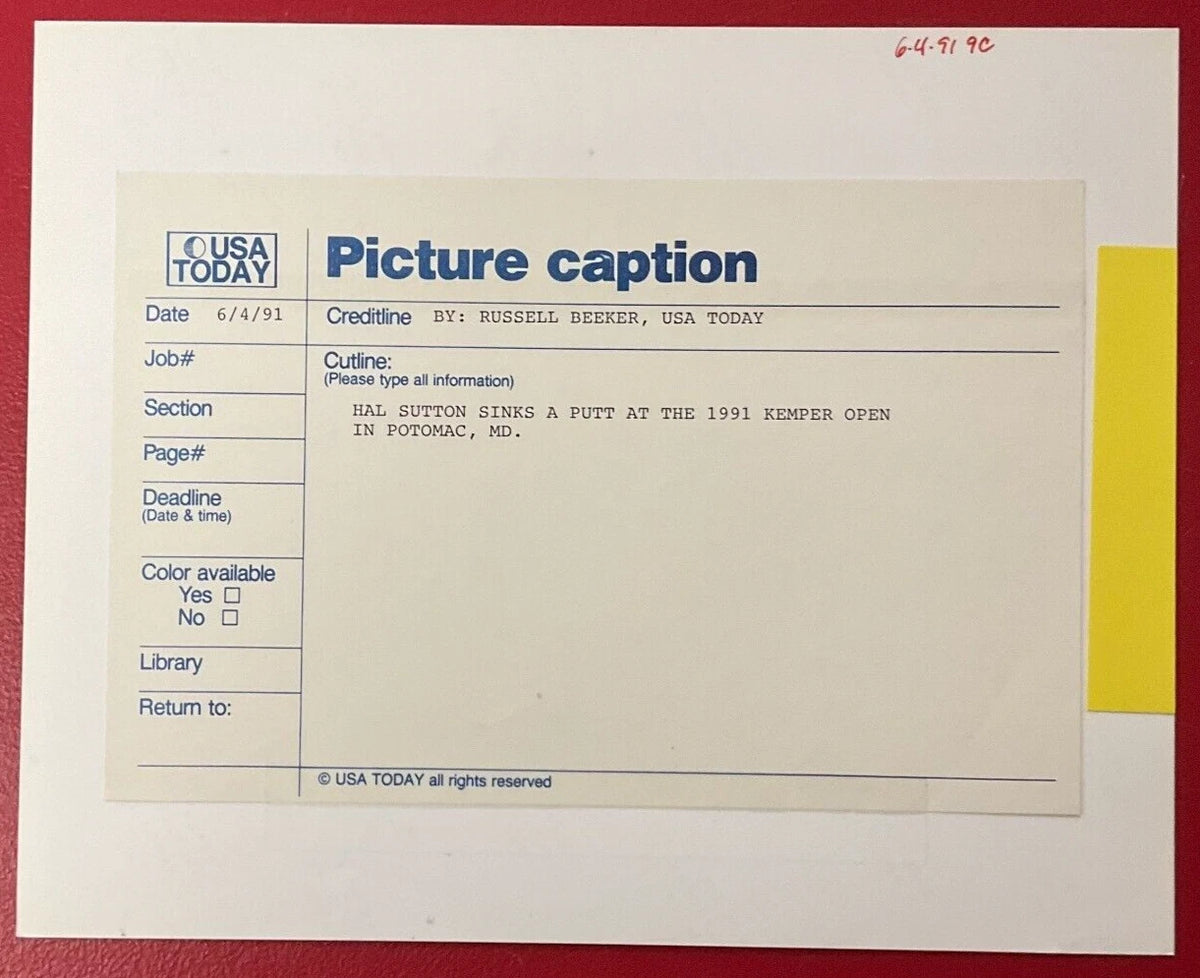
VERSOUSA Today caption card dated 6/4/91, typed cutline, a red notation at the head that appears to read 6-4-91 9C
Sinking a putt, in a Jantzen shirt and a TPC cap, the week he opened 66, 65, 64 and finished tied fourth. Grease-pencil crop marks at the corners, the way the desk sent it to the page.
Read the file
The week
The 1991 Kemper Open was played at the Tournament Players Club at Avenel in Potomac, Maryland, from Thursday, May 30, to Sunday, June 2. Billy Andrade and Jeff Sluman finished on 263, 21 under par, a tournament record, and Andrade won the playoff with a birdie at the first extra hole for his first Tour victory.
Sutton opened 66, 65, 64. His 195 for 54 holes was the lowest on the Tour all season. A closing 72 left him on 267, tied for fourth, four strokes out of the playoff. He had switched to putting cross-handed the week before, at the Byron Nelson; this frame does not show enough of the stroke to see the grip.
The player
Hal Sutton was born in Shreveport, Louisiana, in 1958, played at Centenary College and turned professional in 1981. His peak came quickly: in 1983 he won the Tournament Players Championship in March and the PGA Championship at Riviera in August, one ahead of Jack Nicklaus, led the money list and was Player of the Year.
By 1991 he was in the middle of a long dry spell, without a Tour win from 1987 to 1994. He won again at the 1995 B.C. Open, and in 2000 took the Players Championship, holding off Tiger Woods.
The photographer
The print is credited to Russell Beeker for USA Today.
Reading the back
A USA Today caption card dated 6/4/91 with a typed cutline, and a red notation at the head that appears to read 6-4-91 9C. If 9C is a page, it points to page 9 of the C section on June 4; we have not yet seen that issue. June 4 was the Tuesday after the playoff, so the card was prepared for an edition after the tournament ended.
On the front, grease-pencil marks at the corners show the crop the desk chose. Grease pencil wipes off a print's surface, so an editor could change the crop without harming the photograph.
Open questions
- Whether the picture ran in USA Today on June 4, 1991, page 9C, as the red notation suggests.
- The story the card was filed for, and whether it ran.
- Russell Beeker's years at USA Today.
Sources
SEE THE VERSO
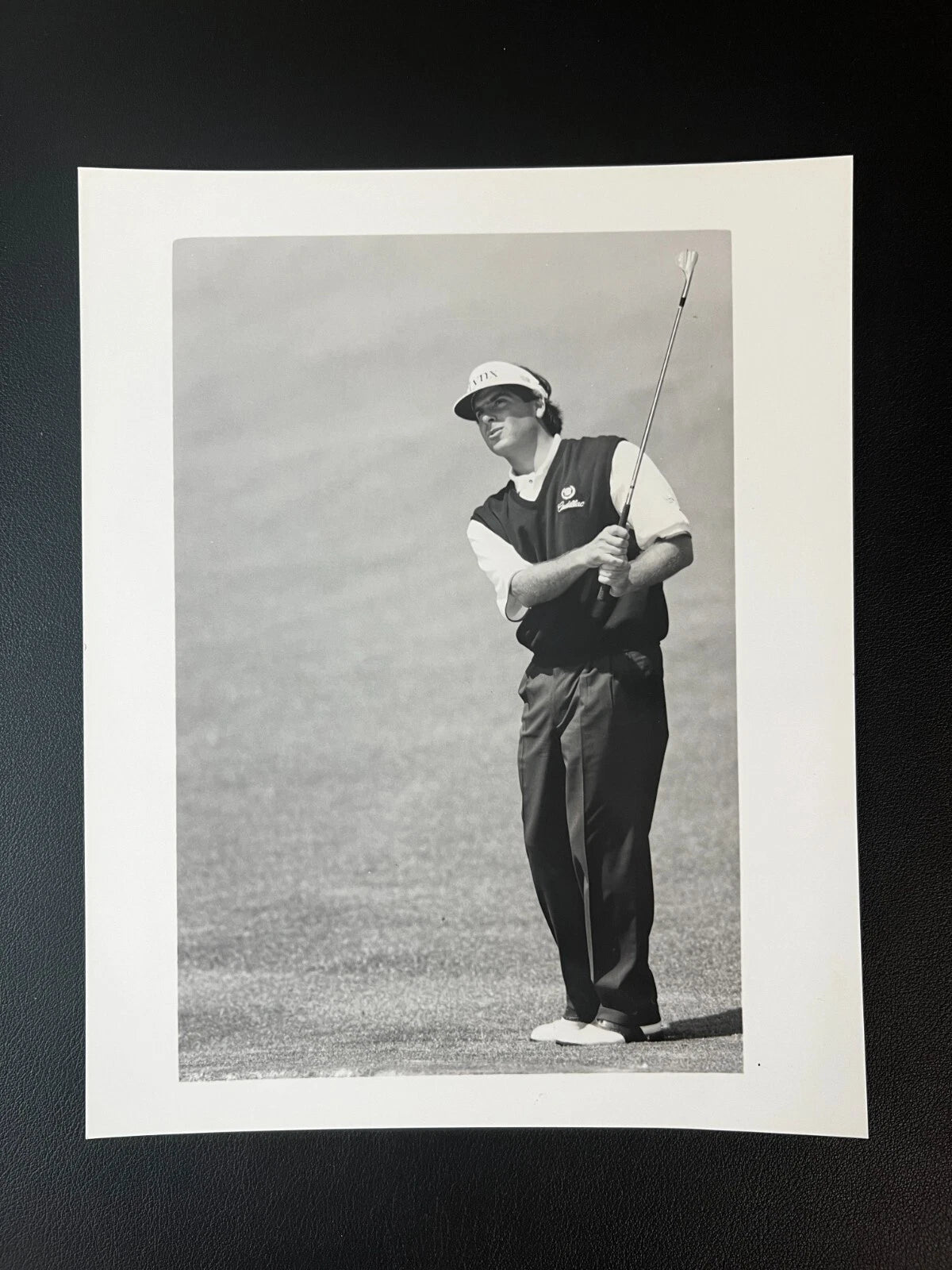
Fred Couples, the 1993 Masters
EVENTThe Masters, Augusta National, 1993
PHOTOGRAPHPorter Binks
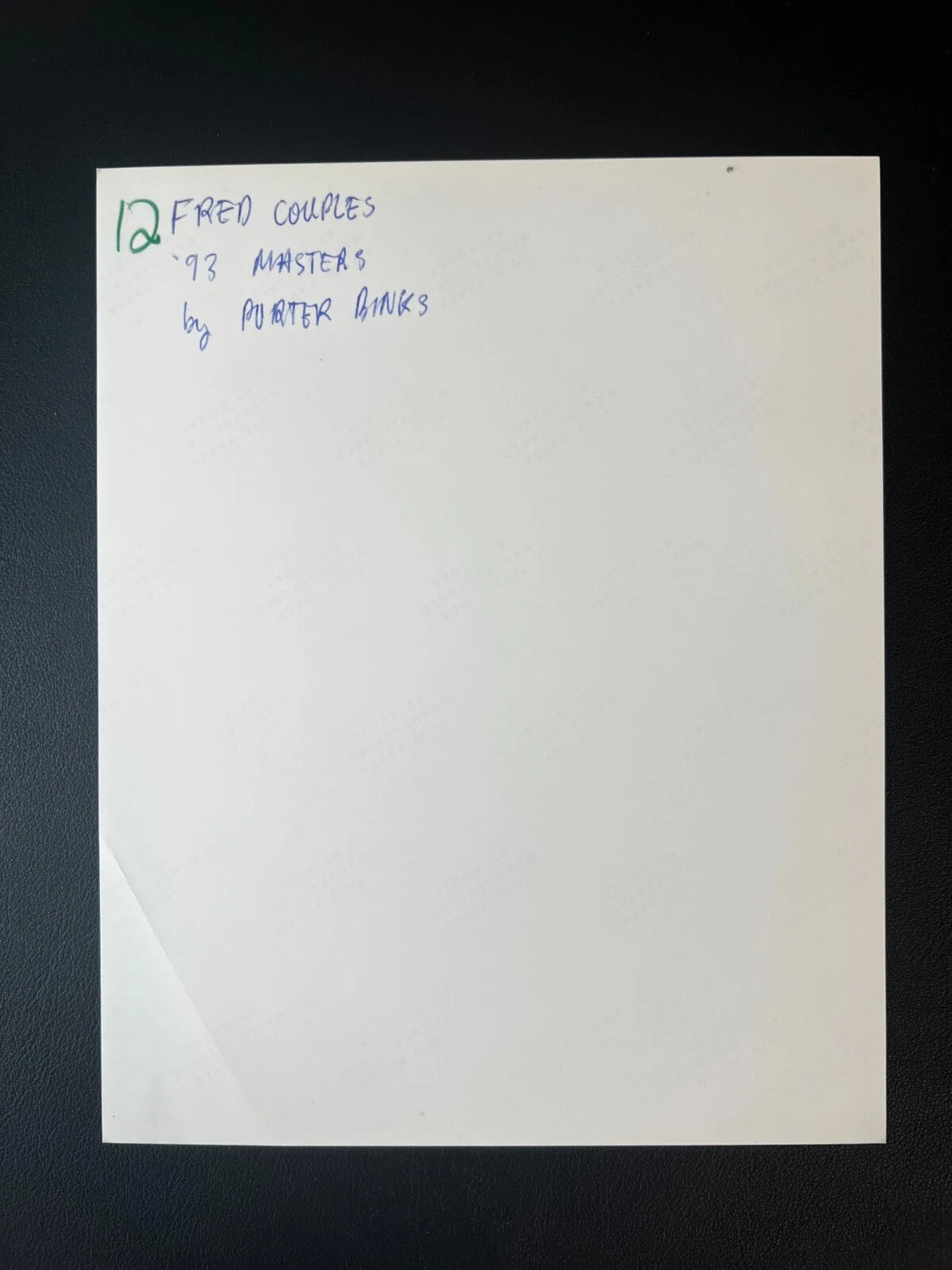
VERSOHand-inscribed in ink: “Fred Couples, ’93 Masters, by Porter Binks,” numbered 12
FRAMINGDouble-framed by Sherman Gallery, Venice, so both faces show
Couples in the Cadillac vest, a year after his green jacket. Everything we know about this print is written on its back, in the hand of whoever filed it. A soft crease at the lower-left corner.
Read the file
The week
The 1993 Masters was played April 8 to 11 at Augusta National. Bernhard Langer won his second green jacket on 277, eleven under, his eagle at the 13th on Sunday decisive, four clear of Chip Beck. Couples came as defending champion and shot 72, 70, 74, 72 for an even-par 288 and a share of 21st. As defending champion he hosted the Champions Dinner that week, and served chicken cacciatore.
The player
Couples had won the year before on 275, thirteen under, two ahead of Raymond Floyd, arriving that week ranked first in the world. In the final round his tee shot at the par-3 12th came to rest on the bank above Rae's Creek and stayed dry. He played on and won: the first American victory at Augusta in five years, and his only major.
Reading the back
Inscribed by hand in ink: Fred Couples, '93 Masters, by Porter Binks. Numbered 12. The inscription names the player, the event and the photographer, and places the print in Couples's year as defending champion. Double-framed so both faces show.
Open questions
- What the 12 records: a print in a sequence, or a file or negative number.
- Which publication Porter Binks was shooting for at Augusta that year. He spent sixteen years at USA Today before ten at Sports Illustrated, which makes USA Today the first archive to search.
- When Couples’s Cadillac contract began. The association was public by February 22, 1993, when the Los Angeles Times reported it, so it predates this Masters.
- Which round, or which practice day, the frame comes from.
Sources
The Record
Gone, but kept on the wall.
The first print leaves the wall this season. When it does, it is recorded here.
Viewing at 1733 Abbot Kinney
The Gallery hangs on the back wall of the room, November 1 to December 31.
ARRANGE A VIEWING THE TYPE I REGISTERTHREE CYPRESS GALLERYABBOT KINNEY SUPPLY · VENICE, CA 90291